In short
- Children aged 6–12 learn art history best through real artworks, short sessions and stories, not lists of names and dates.
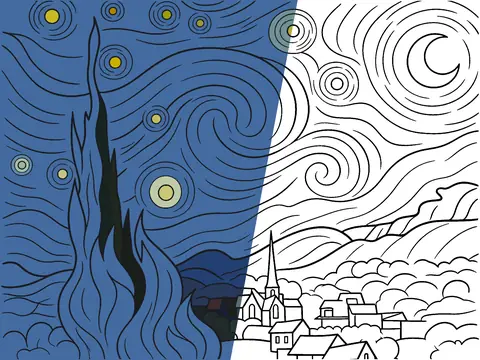
- A coloring page of a real masterpiece gives a child a reason to look slowly at every part of a painting.
- Use a simple routine: look at the real artwork, tell it back, learn one fact, then color.
- Connect each picture to a place on a map and a spot on a timeline, and keep the finished pages as a growing gallery.
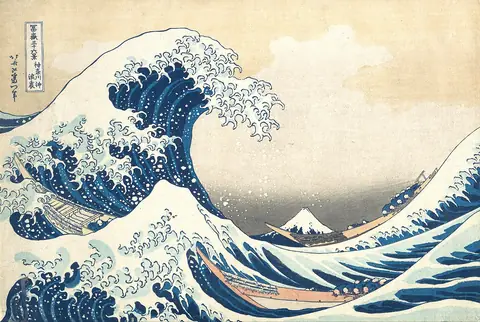
Art history can sound like a grown-up subject: dates, movements, long names in other languages. But children are natural art lovers. Give a seven-year-old Hokusai's Great Wave and ask what is happening, and you will hear about the giant claws of water, the boats and the tiny mountain far away. The trick is not to simplify the art. It is to simplify the way in.
Coloring is one of the easiest ways in. It is familiar, calm and hands-on, and when the coloring page is a faithful drawing of a real masterpiece, it quietly turns into a lesson in looking. Here is a routine that works at home, in a homeschool or in an elementary classroom.
Why coloring a real masterpiece works
When children color, they slow down. To color Bruegel's The Hunters in the Snow, a child has to notice the dogs following the hunters, the skaters on the frozen ponds, the birds in the bare trees and the tiny people far below. That slow, detailed looking is exactly what art historians and museum educators try to teach.
The idea of using the hands to learn about a picture is not new. In her book Home Education (1886), the British educator Charlotte Mason described a “picture talk” lesson in which children studied a painting and then drew its main lines from memory in a few minutes. Coloring a faithful line drawing is a gentler version of the same thing, suited to younger hands.
The key word is faithful. A cartoon version of the Mona Lisa teaches a child to recognize the cartoon. A line drawing that keeps the real composition teaches them to recognize the painting itself, so that one day in a museum or a library book they can say, “I colored that one!”
A simple four-step routine
1. Look at the real artwork first
Before any coloring, show a good color image of the original. A museum website on a tablet or laptop is ideal, because you can zoom in on details. Ask children to look quietly for a few minutes and try to remember everything they can. For younger children, give them something to hunt for: “Can you find Mount Fuji?” or “How many dogs can you see?”
2. Tell it back
Hide the picture and ask, “What did you see?” Let them describe it in their own words. Six-year-olds will list colors, people and animals; older children will start to talk about the weather, the mood or what might happen next. There are no wrong answers here. The point is to turn looking into remembering.
3. Learn one fact, one place and one date
Now add a little knowledge, and keep it little. Read the artwork's title, the artist and the year, and share one fun fact. For example, Georges Seurat painted A Sunday on La Grande Jatte with thousands of tiny dots of color, a technique called pointillism, and it took him about two years. Find the artist's country on a map. One memorable fact sticks far better than five.
4. Color, then compare
Finally, hand over the coloring page. Some children will try to match the original colors exactly; others will invent a purple sky. Both are valuable. Afterwards, put the finished page next to the real painting and ask: What did you keep the same? What did you change? How does it feel different?
Franz Marc's The Yellow Cow is a lovely painting for this conversation. Marc gave colors their own meanings, and to him yellow stood for joy. Ask children what color they would choose for a happy cow, a grumpy cow or a sleepy one.
A sample four-week plan
You don't need a full curriculum to get started. Here is a simple month of art history, with two or three short sessions a week.
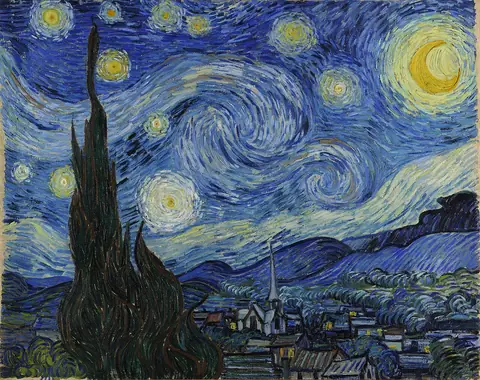
- Week 1: Vincent van Gogh. The Starry Night, Sunflowers and The Bedroom. Van Gogh painted the view in The Starry Night from his window at a hospital in Saint-Rémy, France, and added the little village from his imagination. His Bedroom shows his own room in the Yellow House in Arles, and he liked it so much that he painted it three times.
- Week 2: A bridge to Japan. Hokusai's The Great Wave off Kanagawa and Hiroshige's Sudden Shower over Shin-Ōhashi Bridge. Here is a wonderful link back to week 1: Van Gogh collected Japanese prints and painted his own copy of Hiroshige's rainy bridge in oil paint. Show both versions side by side.
- Week 3: The Impressionists and their friends. Monet's Bridge over a Pond of Water Lilies and Woman with a Parasol, Degas's The Dance Class and Mary Cassatt's Little Girl in a Blue Armchair. Talk about painting outdoors, light and everyday moments.
- Week 4: Around the world. Kim Hong-do's Ssireum (Wrestling) from Korea, Ustad Mansur's Turkey Cock from Mughal India, José María Velasco's The Valley of Mexico and Akseli Gallen-Kallela's Lake Keitele from Finland. Pin each one on a world map.
At the end of the month, a child will know a dozen or more real artworks by name, and will have a stack of finished pages to show for it.
Adapting for ages 6–8 and 9–12
Ages 6–8 do best with very short looking sessions, lots of “I spy” questions and the fun fact read aloud. Don't worry if they color outside the lines or change every color. They are building familiarity, and that is the foundation for everything else.
Ages 9–12 can take on more: reading the facts themselves, writing two or three sentences about the painting, researching where it hangs today, or ordering their finished pages into a timeline from oldest to newest. Many enjoy a challenge such as “color it exactly like the original” using the real painting as a guide.
Build a gallery, not a pile
Children take their work more seriously when it is displayed. Hang finished pages on a string with clothes pins, make a timeline along a hallway, or keep them in a folder labeled “My Museum.” A gallery checklist, where children tick off each artwork as they finish it, adds a satisfying sense of progress. When the collection is complete, celebrate with a small “gallery opening” for family members, with the young artist as the tour guide.
Common mistakes to avoid
- Too many facts at once. One good story per painting is enough.
- Skipping the real artwork. The coloring page is a companion to the masterpiece, not a replacement for it.
- Insisting on “correct” colors. Curiosity matters more than accuracy, especially for younger children.
- Sessions that run too long. Stop while it is still fun, and the next lesson will be easy to start.
Art history doesn't have to wait for high school. With a real masterpiece, a few minutes of careful looking and a box of crayons, a six-year-old can begin a lifelong friendship with great art. For Japanese art in particular, our guide to Hokusai and The Great Wave is a good next step, and homeschoolers may enjoy our beginner's guide to picture study.