Quick facts
- Artist: Katsushika Hokusai (1760–1849), Japan
- Made: around 1831, during Japan's Edo period
- What it is: a woodblock print, about 25 × 37 cm (roughly the size of a large sheet of drawing paper)
- Series: the first print in Thirty-six Views of Mount Fuji
- Japanese title: Kanagawa-oki nami ura, which means “Under the Wave off Kanagawa”
It might be the most famous wave in the world. You have probably seen it on posters, mugs, T-shirts and even emoji. But The Great Wave off Kanagawa is much more than a pretty pattern. It is a dramatic story about fishermen, a lesson in how prints were made in old Japan and the work of an artist who never stopped trying to get better. Here is everything curious kids (and their grown-ups) need to know.
Who was Hokusai?
Katsushika Hokusai was born in 1760 in Edo, the city we now call Tokyo. He started painting when he was six years old. At twelve he worked in a bookshop, and at sixteen he became an apprentice to a woodblock carver. At eighteen he began studying with a well-known print artist, Katsukawa Shunshō.
Hokusai worked for about seventy years, and he was famous for changing his name. He used at least thirty different art names during his life, often starting a new name when he began a new style of work. Late in life he called himself Gakyō Rōjin Manji, “the Old Man Mad About Art.”
He was also wonderfully modest about his own skill. In his seventies he wrote that nothing he had drawn before the age of seventy was really worth noticing, and that he hoped to keep improving until, at more than a hundred years old, every dot and line he drew would seem alive. He made The Great Wave when he was about 71.
What's happening in the picture?
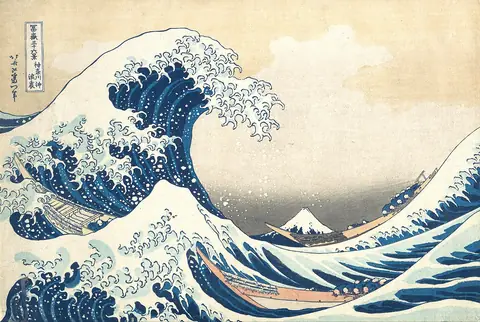
Look closely and you will find three things: a stormy sea, three boats and a mountain.
- The wave. A huge wave curls over the boats. The white foam at its tips looks like fingers or claws reaching down. Vincent van Gogh and his brother Theo noticed this too. In a letter written in September 1888, Vincent repeated Theo's words about Hokusai: “these waves are claws, the boat is caught in them, you can feel it.”
- The boats. The long boats are fast cargo boats that carried fresh fish to the markets of Edo. Look for the rowers bending low, holding on as the wave rises above them.
- The mountain. That small, snow-topped peak in the middle is Mount Fuji, the tallest mountain in Japan. It looks tiny only because it is far away. Can you spot the little wave in front that is shaped just like Mount Fuji?
- The writing. In the top left corner, a box holds the title of the series and the name of the print. Next to it is Hokusai's signature. At the time he was using the name Iitsu, so the signature says the print is by Iitsu, formerly Hokusai.
Some people say the picture should be “read” from right to left, the way Japanese writing traditionally runs. Read that way, the wave is rushing toward us, and the boats are heading into it. Try looking at it both ways. Does it change the story?
How was it made? The secret of woodblock prints
The Great Wave is not a painting. It is a woodblock print, and making it took a whole team:
- The artist (Hokusai) drew the design in ink on thin paper.
- The carver glued the drawing face down onto a block of cherry wood and carved away everything except the black lines. This first block is called the key block.
- More blocks were carved, one for each color.
- The printer brushed ink onto each block in turn, laid damp paper on top and rubbed the back with a flat pad called a baren. Lining up every color perfectly took great skill.
- The publisher, a man named Nishimura Yohachi, paid for the project and sold the prints in his shop.
Because the blocks could be used again and again, many copies could be made. Experts estimate that about 8,000 copies of The Great Wave were eventually printed, and over a hundred early impressions still survive today.
The famous deep blue has its own story. It is Prussian blue, a man-made pigment first created in Europe. It had arrived in Japan not long before, and Hokusai used it so boldly in this series that it helped change Japanese printmaking. The earliest prints in the series were made mostly in shades of blue.
Why is it so famous?
When Japanese prints reached Europe in the second half of the 1800s, artists were amazed. Their bold outlines, flat colors and unusual viewpoints inspired painters such as Claude Monet and Vincent van Gogh. The French composer Claude Debussy loved The Great Wave so much that he hung it in his home and asked for it to appear on the cover of the printed score of his orchestral piece La Mer (“The Sea”), first performed in 1905.
Today it is often described as one of the most reproduced images in the history of art. Museums that own an early impression usually show it only for a few months at a time, because the paper and colors fade in the light.
Hokusai's family of artists
Hokusai was not the only artist in his household. His daughter, Katsushika Ōi, was a talented painter who worked in his studio, and Hokusai praised her skill at painting people. Children are often delighted to learn that the artist of The Great Wave had a daughter who was an artist too.
Activities to try
- Find Fuji. Show the print and time how quickly children can find Mount Fuji. Then look for the small Fuji-shaped wave.
- The blue challenge. Color a Great Wave page using only blues, plus white for the foam, the way the early prints in the series looked. How many different blues can you make?
- Be a printmaker. Press a design into a sheet of craft foam with a blunt pencil, roll washable paint over it and press paper on top. Each print comes out reversed, just like a real woodblock print.
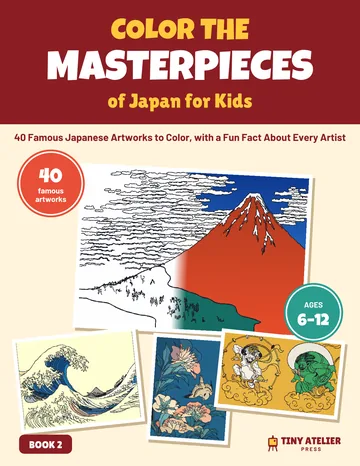
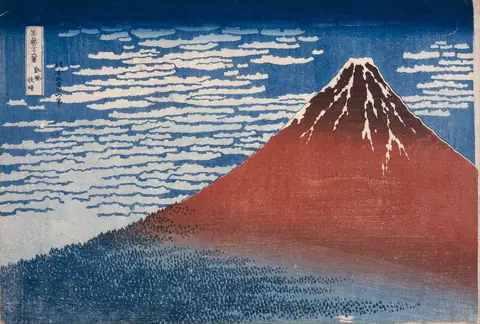
- Compare two Fujis. Put The Great Wave next to Red Fuji (Fine Wind, Clear Morning) from the same series. One is stormy and one is calm. What did Hokusai change to create each mood?
- Tell the fishermen's story. Ask older children to write what happens next. Do the boats make it home?
Want more famous artworks to explore with children? Try our list of 10 famous paintings every child should know.